From University of Pisa to EPFL: My Story
Chasing a dream that once felt impossible
October 2, 2025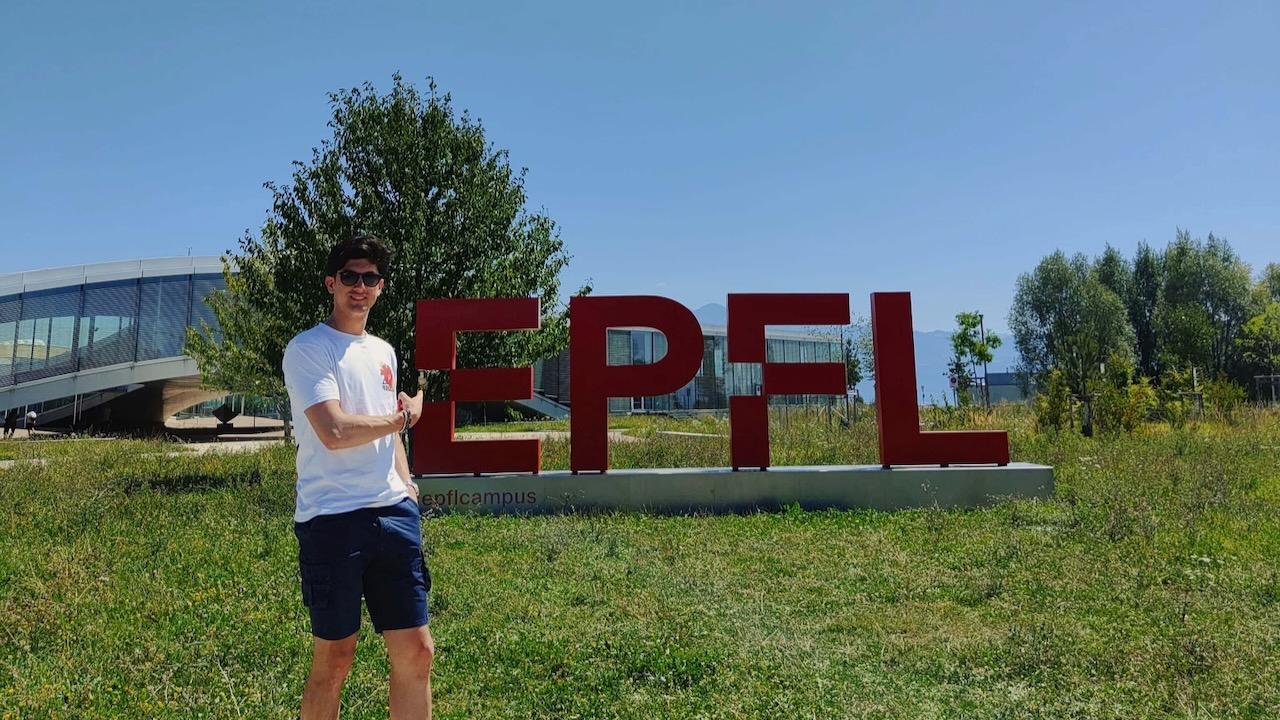
Myself at Rolex Learning Centre, in front of EPFL sign.
Since childhood, I’ve been fascinated by how things work, but no object captured my attention like a computer. That curiosity grew quickly into a passion, one that has guided almost every decision I’ve made since. I was lucky enough to have a neighbor who shared his knowledge with me: he taught me the basics, answered my endless questions, and encouraged me to explore on my own. Those first experiments and explorations guided by my curiosity and mentorship planted the seed of a passion that would only grow stronger with time.
This passion eventually led me to pursue my Computer Engineering bachelor’s degree at the University of Pisa, my hometown, where I spent three intense years full of challenges, sacrifices, and growth. Along the way many things changed: I left competitive sports behind, devoted countless hours to study, and learned the value of resilience and determination.
Looking back, I realize that all the Saturday nights I spent at my desk instead of going out with friends were not in vain. They led me here: to completing my Bachelor’s degree and being admitted to the Master’s in Computer Science at EPFL, a university I had always heard about with admiration and never truly expected to reach.
In this post, I would like to share my journey toward reaching this goal, highlighting the challenges I faced and the lessons I wish I had learned earlier, in the hope of inspiring other students who dream of achieving the same.
Before University: First steps into Tech
During high school, I discovered my true passion for programming. At a time when artificial intelligence was still far from being mainstream and building websites was a complex craft, I began creating my very first websites for acquaintances. I started by teaching myself the basics such as HTML, CSS, and PHP, and soon I was creating custom WordPress sites that allowed clients to update and manage their content independently, without needing my constant intervention. As my curiosity grew, I moved on to more advanced technologies such as React, Next.js, and Node.js, spending countless afternoons experimenting with projects and building clones of existing websites just to understand how they worked.
This growing passion eventually gave me the opportunity to work as a frontend developer in a small startup during my final year of high school. The team was building a mobile application designed to help beach volleyball players register for tournaments and make it easier for organizers to manage events. I met the founders right on the sand, while playing beach volleyball myself, and soon I became part of the project. For the first time, I had the chance to work on something that could have a real impact on people’s lives. Seeing my friends use the app I had helped to develop made me incredibly proud and confirmed that this was the path I wanted to follow.
High school also gave me something invaluable: time. I could spend entire afternoons experimenting, exploring new technologies, and building projects purely out of curiosity. That freedom to create without deadlines or pressure was crucial in shaping both my skills and my passion. Only later, once I entered university, did I realize how rare that free time would become, and how the next stage of my journey would demand far more discipline, resilience, and sacrifice.
The University of Pisa Journey
I have always had clear ideas about my future. Already during high school, I felt that Pisa was too small for me: always the same people, few opportunities, and the sense of being stuck in my hometown, still living with my parents, made me feel constrained. I still remember countless walks at night with a close friend through the streets of Pisa, telling her that one day I would find a way to leave. At the same time, I knew that staying in Pisa for my Bachelor’s would give me the chance to focus entirely on my studies without external distractions, and to prepare myself for the bigger step I was determined to take during my Master’s.
This is why I decided to start my academic journey at the University of Pisa. Despite the limitations I felt from my hometown, the university itself has an excellent reputation in scientific and engineering fields, and I knew it would provide me with strong foundations. But deep down, I was always certain of one thing: Pisa was only going to be a starting point, never the destination. I knew I wanted to aim for bigger opportunities.
First Impact
For many students, the transition from high school to university can feel like a shock. In my case, it was less traumatic: during my final year of high school, I had already developed strong discipline and a habit of organizing my work independently. This helped me adapt quickly to the new environment and find my rhythm as a university student.
Still, one of the first things I noticed at the University of Pisa was how theoretical the program was. Courses were focused heavily on mathematical foundations and rigorous theory, which provided me with strong fundamentals but left little space for practical projects or experimentation. After spending high school afternoons building websites and developing applications, I initially found this frustrating, yet I also understood it was shaping my way of thinking, teaching me how to approach problems methodically and build knowledge on solid ground.
Challenges and Difficulties
I would be lying if I said that these three years were simple. On the contrary, earning my Bachelor’s degree in Computer Engineering is without a doubt the most important, and difficult, achievement of my life so far.
Some exams were extremely challenging, and I constantly lived with the fear of not making it. On top of that, I knew from the beginning that if I wanted to pursue my Master’s at another university, I had to graduate on time. That meant I could not afford to fail a single exam. This awareness added constant pressure and turned these three years into a highly stressful experience, one that often prevented me from fully enjoying university life.
Looking back, I realize this is something I could have handled differently. I could have allowed myself more space to gain work experience and internships during my early university years, instead of focusing exclusively on completing the program as quickly as possible. At the time, however, I had made a clear decision: to finish my Bachelor’s as soon as I could, and to dedicate myself to internships and professional experiences later, during my Master’s.
One episode that I remember vividly is my very first exam: Foundations of Programming. The exam was structured with a pre-test, a practical part, and finally an oral exam. I passed, but the grade I received on the practical part didn’t satisfy me. After completing the oral, I made the difficult decision to refuse the grade and try again at the next session.
At first, walking out of that room, I felt almost relieved, as if I had taken control of my path by not settling for less than I wanted. But as the adrenaline faded, reality hit me. I had just thrown away weeks of effort, and the certainty of having another exam completed. That night, and many nights after, were some of the worst of my life. I lay in bed staring at the ceiling, my mind racing, asking myself if I had just made a huge mistake. I had already spent an entire month locked in my room studying, and the thought of starting all over again felt unbearable. What had seemed like a brave choice in the heat of the moment suddenly looked like pure madness.
And yet, looking back, I realize it wasn’t madness at all. Before even walking into the exam, I had already decided that if my grade didn’t reach a certain threshold, I would refuse it. I had weighed risks and benefits in advance, while my mind was calm and clear, so that in the stressful moment I would simply follow through on a rational choice. That preparation saved me from acting impulsively, even if, once emotions took over afterwards, I doubted myself deeply.
In the end, I did study again and eventually earned the grade I truly wanted. But the real value of that experience lies in the lessons it taught me. First, that striving for perfection can be both a strength and a weakness: it can drive you to achieve more than you thought possible, but it can also trap you in endless stress. And second, that important decisions should never be made in the middle of stress or adrenaline, they must be planned calmly in advance, so that when emotions inevitably come, you already know the path to follow.
Those two lessons stayed with me for the rest of my degree. From then on, I never refused another grade, because I had learned how to balance ambition with pragmatism, and how to let rational planning guide me instead of raw emotion.
Giving up Competitive Sports
I have always been a very athletic person, and even today I still think of myself as sporty and competitive, even if less than before. My sporting journey has been fundamental to my growth.
It all started with football when I was six years old, which helped me tame a personality that was too individualistic and stubborn. But every Saturday, after taking off my cleats, I would rush to the gym to watch my cousin’s volleyball matches. That’s where I first fell in love with the sport and realized that football didn’t give me the same emotions. At the age of ten, thanks to my rapid growth, I decided to dedicate myself fully to volleyball, and for the next eight years it became the center of my life.
Volleyball taught me discipline: the late-night practices until 1 AM, the constant fatigue, and the joy of being part of a team working toward a common goal. It also taught me leadership: the courage to take responsibility for the team in the most difficult moments, learning to perform under pressure when it really mattered.
In my last year of high school, during Covid, I decided to close this chapter of my life. Playing on a team meant responsibility, and I knew that with university ahead, I couldn’t just say “I have an exam tomorrow, I won’t be at the practice.” Quitting volleyball, however, was anything but easy. It felt as if I had suddenly taken the very thing that had been the center of my life and locked it away in a drawer, never to be opened again: all the practices, all the car rides with my mom to weekend matches, all the sacrifices I had made chasing that blue and yellow ball. Letting go felt like killing a part of myself, erasing my identity, but deep down I knew it was necessary.
To fill that void, I turned to beach volleyball, which to me is still the most enjoyable sport in the world. There’s nothing quite like competing under the blazing August sun at noon, with sand burning under your feet and the echo of the ball cutting through the silence. Beach volleyball taught me calm, focus, and communication, but also reminded me that joy and struggle often come together.
Still, as university progressed, I realized that my total dedication to studying was holding me back in the sport. I would go to practice, but my mind was elsewhere, already on the next exam. And as a naturally competitive person who always wants to improve, the frustration of not progressing grew too heavy. After two years, I eventually decided to stop playing competitively altogether.
Since then, I’ve kept training regularly at the gym, but earlier this year I also started dancing salsa and bachata: something I had always loved but never had the chance to truly learn. Music has always been at the center of my life: whatever I do, there’s music in the background. It has the power to change my mood instantly, and I honestly couldn’t live without it. Being able not just to listen to music but to embody it through dance had always fascinated me.
What I love most about these dances is that there’s no fixed choreography: you learn the steps and figures, and suddenly you can dance with anyone. It becomes a universal language: a way to communicate, to connect, and to express yourself without saying a word. Wherever I go, I can walk into a dance venue and, without speaking the local language, share a song on the dance floor with people from all over the world. For me, that’s pure magic.
It’s also the only non-competitive activity I’ve ever done: I don’t dance to win; I dance to let go. In fact, lately it has been the only thing keeping me from turning into an algorithm, a living reminder that in a life driven by logic and formulas, we all need a touch of art. I like to say that even an engineer’s life needs art, and this is mine.
JEVIS: Finding My Community
As I mentioned earlier, the University of Pisa is very theoretical and has limited connections with industry. One of my goals before starting university was to meet other students as motivated as I was about entrepreneurship and the startup world, but during my first year, there was no sign of that.
Everything changed one summer, when a close friend of mine casually mentioned that he was joining a group of students who were about to found the Junior Enterprise of the University of Pisa, and asked if I wanted to be part of it. At first, I hesitated: the upcoming semester included Logical Networks, the most feared exam in the entire Computer Engineering program, and I wasn’t sure I could handle both. But a few months later I realized this was an opportunity I couldn’t afford to miss. So, during the first recruitment campaign, I applied and became one of the very first members of JEVIS.
If I have reached the goals I set for myself and become the person I am today, I definitely owe a great part of it to JEVIS. Within the association, I had the privilege of meeting brilliant people from different fields of study, who taught me to approach problems from multiple perspectives. With them, I was able to exchange ideas about my future choices, share my dreams and achievements, but also open up about my struggles. These conversations and connections were invaluable, and I am truly grateful for them. Above all, JEVIS reminded me of something essential: we become the product of the people we spend the most time with. Surrounding myself with such motivated and inspiring peers pushed me to become the best version of myself.
JEVIS also gave me the opportunity to work on real projects as a project manager, leading a team of associates in delivering two client websites. It was a hands-on experience that pushed me to grow not only as a professional but also as a person.
Now that I have left the association to start my Master’s at EPFL, I hope to remain a point of reference for the next generation of members, sharing advice and helping them pursue their ambitions, just as others once did for me.
What I’ve Learned
Looking back at my three years in Pisa, I realize that the most valuable lessons I learned had little to do with formulas or algorithms, and much more to do with myself.
The first lesson was that perfectionism is a double-edged sword. It has been both my greatest ally and my biggest weakness. My very first exam showed me how dangerous it can be to always chase perfection: it drives you to aim higher, but it can also create unnecessary stress. Sometimes, the wisest choice is to be pragmatic and grateful for what you’ve already achieved, rather than pushing endlessly for more.
Another lesson I learned is the importance of long-term vision. Ever since high school, I knew that Pisa would only be a starting point and that my true goal was to pursue my Master’s abroad. That clarity was like a compass: it reminded me why I was studying so hard, why I was giving up sports and nights out, and why I was enduring the constant pressure. Without that vision, I doubt I would have had the resilience to keep going during the toughest moments.
But vision alone is not enough. I also realized how crucial discipline and organization are when it comes to making the right decisions. More than once, when I acted in a hurry, I ended up choosing poorly. Good decisions require planning, method, and the ability to weigh options carefully. Combined with a long-term vision, this mindset allowed me to prioritize what really mattered and avoid wasting energy on things that didn’t serve my bigger goal.
Perhaps the most transformative lesson of all was the importance of surrounding myself with the right people. You can be motivated, disciplined, and ambitious, but without the right environment and the right peers, progress is limited. Through JEVIS I experienced how much you can grow when you are surrounded by brilliant, driven people who challenge you, inspire you, and support you. I also learned that the smartest approach is not to see others as rivals, but as allies and teachers. Being open to learning from them, celebrating their successes, and drawing inspiration from their achievements made me stronger. After all, if they could succeed, it meant that I could too. In the end, we truly become the product of the people we spend the most time with, and choosing those people wisely is one of the most powerful decisions we can make.
One more thing I learned, though I didn’t always manage to put it into practice, is the importance of taking care of myself. Resting enough, protecting my sleep, and keeping my body active through sports are not luxuries, but necessities. Too often I sacrificed these aspects, by not going to the gym or waking up at 5AM, believing that more hours of study would automatically lead to better results. In reality, I later understood that studying less but more effectively, while keeping a healthy balance, is far more sustainable. Taking care of your mind also means taking care of your body, and this is a lesson I will carry with me here at EPFL.
The EPFL Dream
I had always known that I wanted to pursue my Master’s outside of Pisa. At first, I considered staying in Italy: Politecnico di Milano or Politecnico di Torino seemed like the natural choices. But after two years at the University of Pisa, I began to feel less challenged. The courses were rigorous, but the environment no longer pushed me to give my best, and I needed more stimulation to grow. What I was really looking for went beyond classes or rankings: I wanted to be in a place where I could surround myself with exceptional people, learn from them every day, exchange ideas, and ultimately work toward my greatest ambition: building my own tech startup.
The truth is that EPFL had already crossed my mind, but I had quickly dismissed the idea because of how expensive life in Switzerland is. I told myself it was unrealistic, that I should focus on safer options in Italy. But after my Software Engineering exam, something changed. I realized that if I already felt stuck at this stage, the situation would only get worse if I didn’t push myself into a new environment. That was the moment I decided that, no matter how intimidating the financial cost looked, I had to at least try. I knew that if I didn’t, I would regret it for the rest of my life.
The Application
The application process itself turned out to be a really intense period of my Bachelor’s. Luckily, I had planned ahead: by anticipating one exam, I only had two left for my final semester, which gave me enough room to dedicate serious time to my application. I spent an entire week writing my statement of purpose, a week when I didn’t attend a single lecture, and nearly a month chasing professors around their offices to ask for recommendation letters.
I still remember the moment when a professor told me he couldn’t write me the letter because, in his words, he “didn’t know me well enough.” And of course, he was right: I hadn’t worked closely with him, and I couldn’t blame him for being honest about it. What made it harder was that he was a highly respected professor, and his support would have carried significant weight in my application. I still remember walking out of his office, almost ashamed for having asked in the first place, and with the fear that his no could be the very reason I might never pursue my dream. At that point, I was missing just one out of the three required letters, and the truth was that I didn’t know many other professors well enough to ask. For a moment, I thought about giving up, telling myself that maybe it was too difficult and that I wouldn’t make it.
But I refused to let that be the end of my journey. I persevered, went to another professor, and this time I luckily found someone genuinely happy to support me. He even asked me for my CV so he could better understand my journey beyond the classroom and write me a stronger letter. When I walked out of his office, I had a smile as wide as eighty teeth: finally, I had secured the third and final letter I needed. The weight I had carried for days was suddenly gone, replaced by relief and gratitude. In that instant, I realized how much even small victories matter along the way. That “yes” was not just a letter: it was proof that I wasn’t alone in this journey, and that someone truly believed in me.
That moment taught me one of the most valuable lessons of all: no matter how unlikely success may seem, you should never, ever, back down.
The Moment I Discovered
I still remember it vividly: June 12th, around noon. I was at my desk, studying for the last exam, while my grandma was in the living room. I knew the admission results would be released around those days, so every time I heard the familiar ding of a Gmail notification, my heart raced. This time, when I opened Gmail, I immediately saw it: the sender was EPFL. My eyes froze on the screen. Right next to the subject line, Gmail shows the first words of the email, and I could read just a few: “Hereby, we are pleased.”
My heart skipped a beat. I jumped out of my chair, ran into the living room, and started screaming like crazy. My grandma looked at me wide-eyed, half scared and half amused, as if I had completely lost my mind. In that moment, I hugged her so tight, and I remember thinking how surreal it was to be sharing such a life-changing moment in the same living room where I had spent so many ordinary days. I grabbed my phone and began calling everyone I knew to share the news. That was the exact instant I realized my life had just changed forever.
What made that moment even more surreal was how impossible it had always seemed. Getting into EPFL from the University of Pisa, without the background of Scuola Superiore Sant’Anna, was almost unheard of. On LinkedIn, I had only found a single example of someone who had managed it before me. For me, it had always looked like a 99% impossible dream, and yet, against all odds, it had just become my reality.
And that’s when I learned another lesson I will carry with me forever: just because something hasn’t been done before doesn’t mean it’s impossible. It only means no one has managed to do it yet.
Reflections & What’s Next
Looking back, my journey from Pisa to EPFL taught me that hard work, vision, and resilience can turn what looks impossible into reality. Today, I have just started my classes here in Lausanne, with the awareness that the hardest step, moving from Pisa to EPFL, has already been taken. Now it’s up to me to make the most of these two years: to seize every opportunity, learn as much as I can, and surround myself with the brilliant people who will challenge and inspire me. These next steps will shape not just my career, but also the person I aspire to become far stronger than I am today.
If there’s one message I’d like to leave to anyone reading this, it’s this: dream big, work relentlessly, and never back down, even when the odds are against you.